
ProSet Co-founder Shares Expertise to Help Ensure Safe and Secure Modular Connections in Colorado

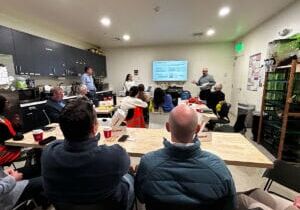
ProSet co-founder Matt Mitchell teaches installation requirements, installer responsibilities, structural connections, and inspection requirements in Colorado. Students learn about the importance of shear walls, hold-downs, structural connections, and their importance when it comes to engineering.
Since 2002, the State of Colorado Division of Housing has required modular home installers to be registered with the Division prior to their first installation. A few years ago, the program was expanded to include commercial modular installations. Matt Mitchell, co-founder of ProSet, was asked by the Division to create a class to help provide continuing education for commercial installers.
Mitchell has been active with the residential program, but he hesitated when asked to create and teach the class because he realized he’d be training his competition. After talking it over with his team, he decided that the opportunity to help ensure that modular installations are done consistently and correctly was too great to pass up.
Mitchell wrote the 8-hour course, which he now teaches with Donny Featherman from the State of Colorado, based on Colorado’s modular installation regulations. Topics covered include installation requirements, installer responsibilities, structural connections, and inspection requirements. Students learn about the importance of shear walls, hold-downs, structural connections, and their importance when it comes to engineering. He even shares the customized tools his company has developed and the rigging they use to lift units, including strap options.
A large part of the modular installation process is logistics, Mitchell said. “With a modular commercial building, there are hundreds of units that are getting shipped over a thousand miles and placed in staging yards. We work with the manufacturer and engineers up front to determine the set order for the units, which is determined by the shear wall and hold-down layout. That determines what order they need to be staged in the staging yard, what order they need to be trucked, and what order they need to be built in the factory.”

Other topics covered in the training include transporting units, crane selection, rigging and setting, permits, street closures, drying in the building, and turnover to the general contractor. “There’s a lot more to it than just getting a crane and moving some boxes into place. It’s a lot to cover in eight hours.”
Students include modular installers, inspectors, and building officials. The class is taught once a year and has been held in various locations around the state, including Denver and Grand Junction. This year, two classes will be offered in the western and eastern parts of the state.
Mitchell doesn’t know of any other states with similar requirements for commercial installations. He said that in California and Montana, third-party inspectors are on-site to verify structural connections and hold-downs, which are often covered quickly during installation. They take photos to document the connections and submit a final report to the building department confirming whether everything has been installed in accordance with the engineering plans.
Ensuring Quality and Safety
In Colorado, a licensed installer must be present at all times when units are being set and connected. The certification process includes ensuring that installers have job experience, including the setting of at least three buildings in an 18-month period. They must also complete a class, pass an exam, and provide a bond.
Projects that don’t have a registered installer are not approved for a certificate of occupancy (CO). “We had a case in Leadville, where someone from out of state installed a building, and they weren’t licensed. The state wouldn’t give them a CO, so they were told to contact me. We had to tear into the walls to see if they’d installed everything properly, and the hold-downs were there. Sure enough, they weren’t, so we had to figure out how to correct it. Once everything was fixed, I signed off on it, and they got their CO.”
Even with a registered installer on site, third-party inspections of the hold-downs and structural connections are required. Inspectors then file a report with the local jurisdiction.
Even with the class he offers, Mitchell believes there’s no substitute for on-the-job experience. “I feel the best way to get educated is to get on a job site and actually do the work. We can talk about it, but when you’re on a site, touching it, seeing it, and feeling it, you get a much better understanding of how everything comes together. People often say that we’ve picked up a box wrong because it’s crooked. We intentionally pick it up crooked so we can set it down and roll through to the next one. It helps us get the draft stopping installed properly.”

Three Decades of Success
Mitchell admits this is his first experience with teaching for the modular construction industry, but he isn’t new to it. “I’ve been doing modular construction for over 30 years, so I feel comfortable with breaking it down, step by step.” He is the co-founder of ProSet and has years of experience in residential modular development, having built neighborhoods in Telluride, Aspen, Vail, and North Dakota, as well as starting his own modular manufacturing facility in Fruita, Colorado, in 2006.
Mitchell started ProSet with partner Scott Bridger, whom he met while working in the oil and gas industry in North Dakota. “Once I left North Dakota, I had some opportunities to set some modular buildings up there, and I asked Scott if he’d like to provide the carpenters, I’d provide a couple of key guys, and we’d set those buildings together. We did it, and it worked out well. So, we started ProSet together in 2014.”
Today, ProSet is one of the leading modular unit installers in the US. After the initial apartment project in North Dakota, they moved on to hospitality projects and were selected by Marriott to install their first modular hotel in Folsom, California. That experience led to contracts with Hilton, Hyatt, and Holiday Inn Express.
When they began the company, they set approximately 400 units per year. Now, they set about 4,000 units yearly for 25 manufacturers in 20 states. “We’re growing with the industry, and we feel the state of Colorado is growing with it, too. It’s the first state to require licensing and continuing education for installers and inspectors, and we wanted to be a part of that.”
Olhando para o futuro
“I think other states are going to adopt similar policies, and it makes sense, as it can be dangerous work. Many states already require licensing for single-family, so I don’t understand why they wouldn’t for multifamily, especially with it growing the way it has over the last few years.”
“Installers should be trained the same way other trades are trained. They should understand what and why they’re doing what they’re doing and the consequences of doing it wrong.”
He applauds Colorado’s efforts to help ensure that modular units are set and connected properly by trained installers. “It’s a good program, and I think other states will follow.”
Sobre o autor: Dawn Killough é escritora freelancer de construção com mais de 25 anos de experiência trabalhando com empresas de construção, subcontratadas e empreiteiras gerais. Seus trabalhos publicados podem ser encontrados em dkilloughwriter.com.
Mais sobre a Modular Advantage
MBI Town Halls 2026: Reflections from Boston
By the end of 2026 MBI’s Government Affairs team will have traveled over 6,000 air miles to bring Town Hall events to five different cities in two countries.

Mind the Gap: The Interface Between Onsite and Offsite Construction
Every design for manufacture and assembly (DfMA) project — modular, mass timber, or panelized — is really two projects joined at a seam. One is built in a controlled factory to millimeter tolerances; the other in the field, in weather, to the looser tolerances of poured concrete and human hands. Between them sits an interface: where the factory’s precision meets the site’s reality.
Rules, Rails & Repeatability: Applying DfMA to Modular Healthcare
DfMA offers several advantages for healthcare projects, with faster delivery among the most valuable. Schedule matters when building new facilities, expanding campuses, renovating existing space or bringing care closer to communities that need it.
Precision and Possibility: Demands of DfMA and What Modular Mass Timber Makes Possible
Mass timber does not automatically create an efficient modular building. Its precision makes early coordination more important: fabricated components will accurately reproduce both the team’s solutions and its mistakes. The material’s advantages are realized only when supported by an equally precise design and delivery process.
Catch It in the Factory, Not in the Field: Smarter Testing for Modular Builds
Integrating watertightness and airtightness testing into factory workflows transforms quality assurance from a reactive process into a proactive commissioning strategy. It ensures that every module shipped is field ready and resilient for transportation while also supporting the ability of the modular construction industry to make buildings better.
Modular Construction Contracts: Key Considerations for Successful Canadian Projects
Starting a modular project with a well-developed contract protects both the owner and the contractor. It will help keep the project on track and on budget, and it will improve quality from the factory floor to final installation on-site.
Modular by Design: Turning Architecture into a Manufacturing System
Modular construction is often presented as a faster way to build. Speed, however, is only one part of its value. The larger opportunity is to create a coordinated design and production system that improves quality, reduces uncertainty, and allows a building to move efficiently from concept design through manufacturing, transportation, installation, and completion.

Repeatability Begins with Trust: What Alora at Dry Creek Reveals About Scaling Modular Housing
Alora at Dry Creek, a 329-unit, multifamily community comprising five four-story buildings in Centennial, Colorado, demonstrates how repeatable design, standardized manufacturing and early collaboration can work together to create a model that is not only faster to deliver, but easier to replicate across future projects.
T.R. Arnold: The Art of Third-Party Inspections
T.R. Arnold (TRA), a third-party inspection company in Elkhart, Indiana, contracts with modular manufacturers across the US. Manufacturers register with each state to which they intend to send their modules and may be required to hire a third-party inspection company.
Creating an ‘Ecosystem for Innovation:’ 50+ Years of Modular Construction Oversight in Virginia
Virginia’s modular building program began in 1973, with the implementation of the Virginia Industrialized Building Unit and Mobile Home Safety Regulations. Now it’s leading the country in modular code adoption.