
Women in Construction – Reflections on a Journey, Then and Now

Laurie Robert is the Senior Sales Strategist at Fero International, Inc.

Laurie Robert speaks at MBI's 2026 Awards of Distinction.
Having dedicated about four decades to Modular Construction, I am inspired by the growing presence of women across a wide spectrum of construction roles today, and notably within our own modular building industry. It is especially meaningful for me to connect with those of you who are shaping your own path in this rewarding field of specialized construction, and I am happy to share some of the lessons learned, stories or insights that helped define my values and influence my direction over time.
Industry Perspectives: Markets and Growth Opportunities
The demand for increased infrastructure in housing, healthcare, education, and commercial markets is very high, driving substantial growth potential in the modular construction industry. In 2015, the Modular Building Institute (MBI) launched its “5 in 5” initiative, aiming to increase Permanent Modular Construction’s (PMC) market share across North America from 2.5% to 5% by 2020. Today, MBI reports suggest that PMC comprises approximately 6% of the commercial construction market in North America, more than doubling that of a decade ago.
Although some may consider this percentage of the total market share modest in the big picture, I view the remaining 94% of the commercial construction market as a vast target for further growth and development—both for modular construction and for women seeking to start or elevate their careers in the industry.
Data suggests that women now constitute approximately 11- 14% of the North American construction workforce, an increase from the late 1990s when women made up approximately 9% of the industry in roles that were predominately administrative. While the roles for women are shifting across administration, preconstruction, and trades, one thing is clear: there are tremendous opportunities for growth for both the industry and for women eager to build or advance their careers in modular construction.
My Path in Modular Construction
Though I consider my entire career to be in the manufacturing side of the industry, my journey in modular construction began in the 1980s when I joined an international space rental company in sales. It was a couple of years later that I had an opportunity to join NRB, a family-owned modular manufacturing company, in a newly formed role as Sales Manager, tasked with building up a new sales team, and expanding business into new markets and regions. It was a very exciting opportunity though in retrospect, I don’t think I fully appreciated the scope of what could be lying ahead of me, most particularly being a woman in construction during the 1980’s and ‘90s. I was fortunate to have the mentorship and support within my company that continually inspired my determination.
In 1992 I became VP of Sales and Marketing, a position I held until my retirement in 2021. As the business grew, my talented sales and estimating team expanded along with it, giving me time to study the broader industry landscape and new potential opportunities that could exist. Joining the Modular Building Institute, we attended annual conferences and explored new market and design possibilities by looking at some incredible projects being built and connecting with other innovative manufacturers across the US and Canada.
I attended regional MBI meetings held along the eastern seaboard to learn everything I could about the challenges and opportunities others may be facing in our industry. It seemed obvious to me that if an entire industry collaborated, we should collectively be able to move the needle and remove some of the barriers along the way.
In 1997 I was elected to the MBI Board of Directors working on various committees and in 2001, I became the first woman and first Canadian President of the MBI. I served a total of 15 years on the board, completing my last term in 2015. In 2013 I was a founding member of the National Institute of Building Science Off-site Construction Council, Chair of the MBI Canadian Educational Foundation and I contributed to the development of the AIA Design Guide for Architects and the Fannie Mae Toolkit for Lenders.
After retiring in 2021, I remained engaged in the modular construction industry by transitioning into a role as a modular consultant, allowing me to stay involved and continue to contribute to academic institutions and organizations committed to advancing the industry.
In 2023, I had the pleasure of meeting Sabrina Fiorellino, a highly driven entrepreneur and the founder and CEO of Fero International, a new modular manufacturing company, and I was happy to join her team as VP of Sales. Fero proudly supports women in construction as an organization where today 30% of the team are women contributing across a variety of roles, including the Executive and Board levels, administration, sales and marketing, project management, purchasing, and skilled trades on the production floor.

Local trade school students, visiting the exhibit hall at MBI’s 2025 World of Modular conference in Las Vegas through MBI’s partnership with the Rising Stars program, speak with an exhibitor to learn more about the industry.
Women in Construction: Past, Present and Future
I share my past story with you to emphasize the importance of being connected, being visible, and being relevant; and how that positively influenced my own path and continues to do so.
Whether you worked in construction in the 1990’s as I did, or are more recently involved today, as I still am, no doubt there may be something to test your resolve as you carve your own path. However, having worked in the industry then and now, I would say that some of the biases or challenges witnessed in the past for women in construction no longer exist, or are much less prevalent today. The doors are much more open.
Here are a few final thoughts from my perspective, for women who are thinking about entering the modular construction industry or are looking to elevate their current position into leadership.
Be visible, be heard and be relevant. Collaboration has been touted as an important component of our industry’s success, and this is true. At the same time, as an individual, do your research, learn from others and strive to bring a fresh perspective or idea to the table and be heard.
Be connected. Connecting with other companies or organizations will help you stay on top of the landscape around you. Communities like MBI’s Women in Construction council are far and away one of the best vehicles to promote the sharing of ideas, opportunities and challenges and to open doors for women in this industry.
Mentoring and Support. For women new to modular construction, mentorship, support, and a welcoming community can build confidence in yourself, your work, and your achievements. If you are an experienced industry professional, take the time to share your experiences and mentor those who are just beginning. Teach what you learn.
What Does the Future Hold?
I see more women participating across a very large spectrum of the industry in various roles and capacities, and these opportunities will continue to grow. Architects and engineers and design assist, preconstruction, project management, production and skilled trades, sales and marketing, estimating, purchasing and administration. There should be no boundaries assuming we all have the requisite skills for each role.
Thank you to all the women working in modular construction today! Throughout my journey I have had the pleasure of meeting many of you that continue to influence the direction we take. Your dedication, drive and the diverse roles each of you play will continue to open doors for all the women of the future.
Mais sobre a Modular Advantage
MBI Town Halls 2026: Reflections from Boston
By the end of 2026 MBI’s Government Affairs team will have traveled over 6,000 air miles to bring Town Hall events to five different cities in two countries.
Mind the Gap: The Interface Between Onsite and Offsite Construction
Every design for manufacture and assembly (DfMA) project — modular, mass timber, or panelized — is really two projects joined at a seam. One is built in a controlled factory to millimeter tolerances; the other in the field, in weather, to the looser tolerances of poured concrete and human hands. Between them sits an interface: where the factory’s precision meets the site’s reality.
Rules, Rails & Repeatability: Applying DfMA to Modular Healthcare
DfMA offers several advantages for healthcare projects, with faster delivery among the most valuable. Schedule matters when building new facilities, expanding campuses, renovating existing space or bringing care closer to communities that need it.
Precision and Possibility: Demands of DfMA and What Modular Mass Timber Makes Possible
Mass timber does not automatically create an efficient modular building. Its precision makes early coordination more important: fabricated components will accurately reproduce both the team’s solutions and its mistakes. The material’s advantages are realized only when supported by an equally precise design and delivery process.
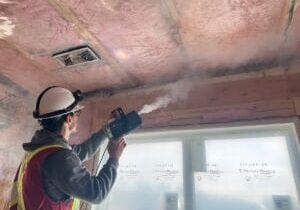
Catch It in the Factory, Not in the Field: Smarter Testing for Modular Builds
Integrating watertightness and airtightness testing into factory workflows transforms quality assurance from a reactive process into a proactive commissioning strategy. It ensures that every module shipped is field ready and resilient for transportation while also supporting the ability of the modular construction industry to make buildings better.
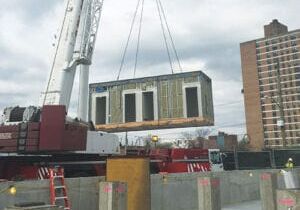
Modular Construction Contracts: Key Considerations for Successful Canadian Projects
Starting a modular project with a well-developed contract protects both the owner and the contractor. It will help keep the project on track and on budget, and it will improve quality from the factory floor to final installation on-site.
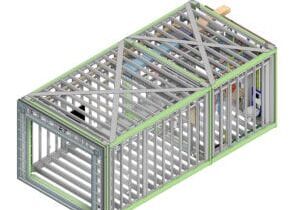
Modular by Design: Turning Architecture into a Manufacturing System
Modular construction is often presented as a faster way to build. Speed, however, is only one part of its value. The larger opportunity is to create a coordinated design and production system that improves quality, reduces uncertainty, and allows a building to move efficiently from concept design through manufacturing, transportation, installation, and completion.
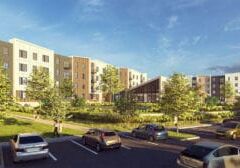
Repeatability Begins with Trust: What Alora at Dry Creek Reveals About Scaling Modular Housing
Alora at Dry Creek, a 329-unit, multifamily community comprising five four-story buildings in Centennial, Colorado, demonstrates how repeatable design, standardized manufacturing and early collaboration can work together to create a model that is not only faster to deliver, but easier to replicate across future projects.
T.R. Arnold: The Art of Third-Party Inspections
T.R. Arnold (TRA), a third-party inspection company in Elkhart, Indiana, contracts with modular manufacturers across the US. Manufacturers register with each state to which they intend to send their modules and may be required to hire a third-party inspection company.
Creating an ‘Ecosystem for Innovation:’ 50+ Years of Modular Construction Oversight in Virginia
Virginia’s modular building program began in 1973, with the implementation of the Virginia Industrialized Building Unit and Mobile Home Safety Regulations. Now it’s leading the country in modular code adoption.