
How Can Airtightness & Quality Assurance Contribute to Successful Industrialized Construction?


Successful, design-led industrialized construction combines products and build quality capable of delivering fabric first performance, with the latest technology capable of supporting the most rigorous quality assurance. The result is not ‘just’ high-quality, offsite-manufactured modules. It also delivers a wholesale change in contracting model based on repeatable quality, de-risked installation and data ownership.
Where module quality and performance are concerned, airtightness is only one aspect of a robust fabric first approach. It is, however, a crucial aspect. Improved standards of airtightness help to avoid excessively thick thermal insulation layers. Coupled with appropriate ventilation, airtightness can also deliver improved standards of comfort within buildings. It is little wonder, then, that sectors embracing industrialized construction increasingly ask for excellent results from airtightness testing.
Case Study: Reds10’s Unique Approach to Industrialised Construction
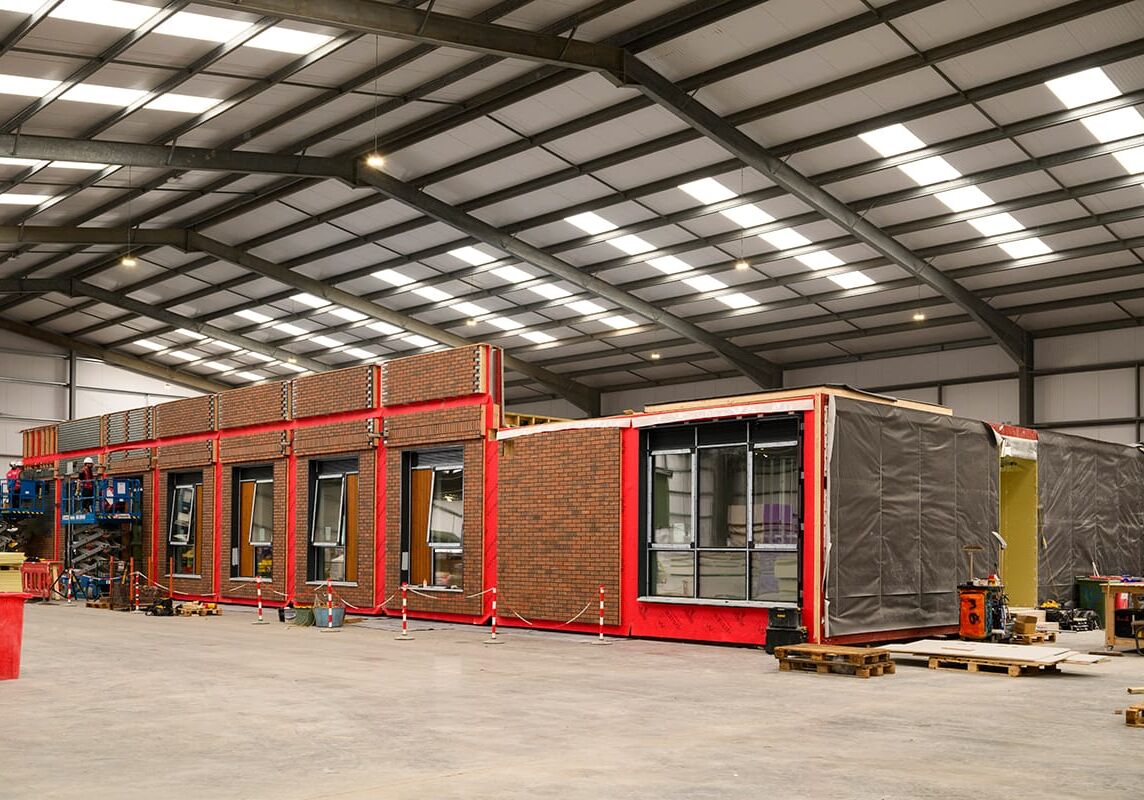
Operating from a 50-acre offsite manufacturing site in Driffield, Yorkshire, Reds10 is redefining how public infrastructure and commercial projects are delivered. 87% of their work is done before a project reaches site, with the aim of optimizing quality, speed and sustainability. The company works across multiple sectors – defense, education, justice, healthcare, residential – and has the capacity to deliver 15,000 units per year.
O desafio
Initially required on defense projects only, Reds10 needed to achieve Passivhaus levels of airtightness, with results of 1 m3/hr/m2 or less. They therefore needed a membrane product that could be applied in the production facility, and with a compatible tape to seal between units once delivered to site. The solution has also needed to prove transferrable as airtight construction becomes a requirement in other sectors that Reds10 works in.
A solução
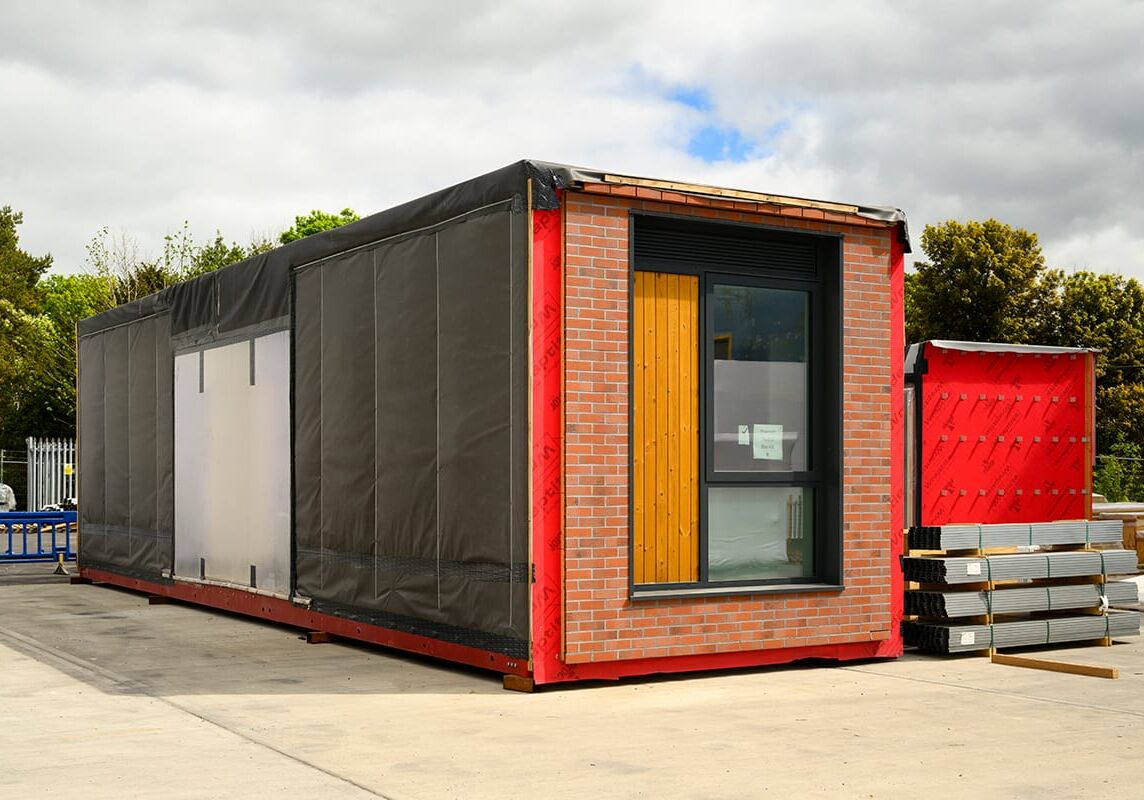
After testing a number of potential solutions, Reds10 chose to adopt Proctor Group’s Wraptite® external air barrier for use on modular units where airtightness was a key requirement. Alongside airtightness, Wraptite offers the benefit of being a membrane that is quick to install and offers water hold out performance while the installed units wait for finishing.
Adopting a Design-Led Approach to Deliver a Product that Looks Good and Performs
Central to Reds10’s growth, and the variety of sectors across which they work, has been adopting a design-led approach. This informs everything they do, including what products they ultimately specify for their units.
A procurement-led approach seeks to drive down cost as much as possible. By contrast, a design-led approach looks at the desired end result, and works out how to get there as efficiently as possible. To avoid fragmentation dragging down productivity, a design-led approach brings more capability in-house and embeds more technology across the business.
In this context, it is possible to see why Wraptite became the airtightness membrane of choice for units that had to deliver what is, essentially, a Passivhaus level of performance.
“We wanted airtightness mainly, but also water hold out and speed of installation,” said Scott Laird, Group Digital and Technology Officer at Reds10. “Two years ago, we might have thought Passivhaus levels of airtightness would be tricky to achieve, but now it’s normal. We have achieved airtightness testing results ranging from 0.67 m3/hr/m2 to 0.97 m3/hr/m2, and Wraptite has made a big contribution to that.”
Proctor Group delivered an initial training session on installing Wraptite. Thanks to its self-adhered nature, no fixings, adhesives or primers need to be used, speeding up the application process and eliminating the cost of accessories or other components
Reds10 took Proctor Group’s training information and installation instructions, and incorporated it into their own standard operating procedures. In this way, they are using Proctor Group’s product expertise and adapting it to suit their specific requirements and deliver the standard of performance they require.
More buildings are benefiting from airtight construction. What started as a requirement only for their defence projects is now being adopted in other sectors in which Red10 operate – at the time of writing, for example, they will soon be using their approach for school projects.
“Speed of application is essential in the factory environment,” added Scott. “At the same time, we also need a nice flat finish from the installation. It stops people asking, ‘What’s wrong with it?’ when the modules are delivered to site.”
Adam Salt, Head of Global Sales Modular Offsite and Head of Business Development at Proctor Group, concurs: “In modular and offsite, presentation is everything. Rather than constructing a building in the traditional sense, you’re delivering a product – and we all expect products we buy to look right. That’s why design capability, as well as delivery capability, is so important for a company like Reds10.”
Where Does Wraptite Fit into Reds10’s Pioneering Quality Assurance?
To achieve the level of transformation seen so far in their contracting model, and to grow it further, Reds10 has enthusiastically embraced technology. The company employs an impressive range of surveying and scanning techniques to capture the build and installation of every modular unit.
It starts with daily capture on the factory floor, and continues with a host of surveys on site as construction progresses. Reds10 uses 360-degree image capture (think Google Street View), drone surveys and LiDAR scans to build up a complete picture of their industrialized construction process. All of the footage is then fed into AI software programs, allowing any stage of a build to be called up, reviewed, and compared with the stages before and after.
Given how quickly units must be made water-tight on site, such an approach makes sense. As soon as modules land, Wraptite tape is used to seal between modular units and needs to be applied as soon as possible.
“Our survey data is more for our own satisfaction than anything else,” said Scott Laird. “It de-risks our approach and helps with answering questions. There have been a couple of projects where being able to review that footage has saved a lot of problems. A good thing about Wraptite is the bright red color helps! You can see very clearly whether something is installed well.”
Developing this integrated approach, and avoiding the fragmentation of traditional procurement, has helped Reds10 to achieve consistency. Their data-driven approach also fits well with the requirements of the Building Safety Act and providing a golden thread.
“Reds10 are a great success story, showing how it’s possible to build a modular offsite business in a sustainable way,” concluded Adam Salt. “Proctor Group is delighted to continue supporting them as they further push the boundaries of what industrialized construction can be.”
Mais sobre a Modular Advantage
From Amsterdam to Brussels: How MBI Is Strengthening Europe’s Modular Construction Voice
By the end of 2026 MBI’s Government Affairs team will have traveled over 6,000 air miles to bring Town Hall events to five different cities in two countries.
From Model to Machine: Why Modular Scale Is Becoming a Software Problem, not a Material One
For modular manufacturers that have already secured demand and repeatable volume, the next major constraint may no longer be forming capacity itself. Increasingly, it is the continuity of the information feeding that capacity.
Who Will Define Modular Products for AI?
Artificial intelligence is making building configurators easier and less expensive to create. This makes urgent manufacturers’ need portable product definitions, stable identities, and shared interfaces regardless of how others’ software is produced.
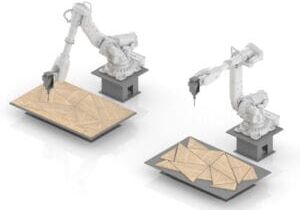
From BIM to Robotic Production: A Digital Workflow for Customized Components in Volumetric Modular Construction
For volumetric modular manufacturers, the value of this workflow is not simply the use of robotics. Its real value is continuity.
Helping Build a Common Framework for Modular Construction in Canada
Canada’s modular construction sector continues to gain momentum, but scaling it successfully will depend on shared expectations across design, manufacturing, approvals, and project delivery. CSA Z251 helps provide that common foundation.
Edges, Exits & Equipment: A Modular Builder’s Guide to Rooftop Access
Rooftop access belongs in the factory design. Before the modules ship, the project team should identify each route’s users, confirm applicable requirements, coordinate with the roof system and structure, and assign responsibility.
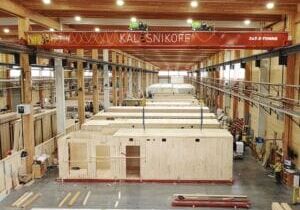
When Timber Production and Modular Construction Share One System
As demand for multifamily and workforce housing continues to outpace what conventional construction timelines can deliver, models that reduce the number of handoffs between structural fabrication and modular assembly are likely to draw more attention.
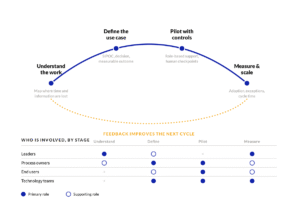
Your AI Strategy Is an Enablement Strategy
Tools will change. Teaching employees only the steps in one platform creates a narrow capability. Involving them in problem definition, process mapping, data assessment, controls, and measurement gives the organization a way to improve its systems as technology evolves.
By-Right Permitting: The Missing Lever for Scaling Modular Multifamily
Modular has already proven it can outperform traditional building methods on speed and cost per unit. The next frontier is outside the factory in the front end of the process, where projects either clear a path to construction or get stuck in review.
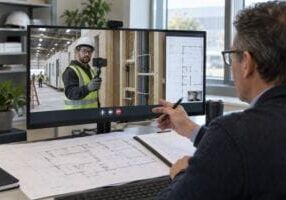
Remote Inspections and The Future of Factory Oversight
Remote inspection is becoming a practical part of modular construction oversight. Its value is greatest when it is used selectively, governed by clear procedures, and supported by complete traceability.