
How Stack Modular Is Using AI to De-Risk Mid- to High-Rise Modular Construction
And What Attendees Can Expect from Stack’s Stuart Marshall at the 2026 World of Modular
Artificial intelligence is no longer a future concept in modular construction—it is already reshaping how complex buildings are evaluated, designed, and delivered. Few companies illustrate this shift more clearly than Stack Modular, where AI has become a practical tool for feasibility, cost certainty, and logistics planning on some of North America’s most ambitious hybrid modular projects.
That real-world experience is what Stuart Marshall, Director of Global Sales at Stack Modular, will bring to his breakout session, “AI in Hybrid Modular Construction: Feasibility, Design, & Global Logistics for Mid- to High-Rise Buildings,” at the 2026 World of Modular Conference and Tradeshow, taking place April 20–23, 2026, at the Bellagio Hotel & Casino in Las Vegas and presented by the Modular Building Institute (MBI).
From Field Problems to Front-End Certainty
Marshall’s perspective on AI is shaped by two decades in modular and offsite construction—and by seeing what happens when critical decisions are made too late.
“I came into modular construction through working in the drywall industry and supporting early modular projects that were struggling with real on-site challenges like fire ratings, acoustics, durability and schedule pressure,” he says. “What drew me to modular was that it forces those decisions to be made earlier, in a controlled environment, instead of reacting to them late in the field.”
As the industry moved from 2D drawings to BIM and 3D modeling, Marshall and his team at Stack Modular saw AI as a natural next step—not as a replacement for expertise, but as a way to make experience more effective.
“Ultimately, better tools lead to better outcomes when they’re used by experienced people,” he says. “I see AI the same way—not as a replacement for engineering judgement or project expertise, but as a practical way to speed up early option comparisons and improve decision-making.”
AI as an Enablement Tool, Not a Sales Gimmick
As Director of Global Sales, Marshall is clear that Stack’s business remains human-driven.
“Our business is built on trust, relationships and experience, which are inherently human-centric, and AI doesn’t replace that,” he says. “The balance is struck by positioning AI as the ultimate enablement tool for our people.”
At Stack, AI is used to handle data-heavy early work—running feasibility simulations, comparing cost and logistics scenarios, and testing assumptions—so teams can focus on higher-value work.
“That gives us more time to focus on what matters most: advising clients, building relationships, solving problems creatively and guiding projects toward the best outcome,” Marshall says. “Our people, leveraging AI, deliver a level of service, speed, and de-risking that neither could achieve alone.”
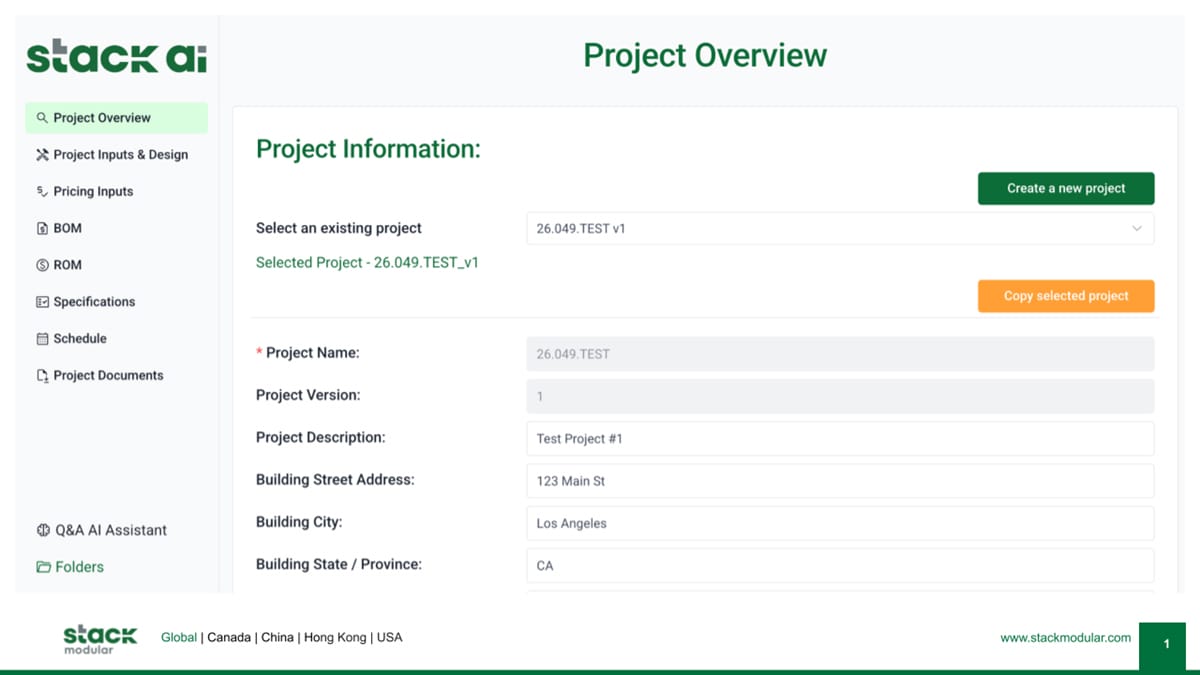
Where AI Is Making the Biggest Impact
For Stack’s mid- to high-rise hybrid projects, AI plays its most important role early, when decisions have the greatest downstream impact.
“Success depends on rapid iteration and early de-risking,” Marshall explains. “AI fundamentally enables us to manage the massive complexity of tall hybrid projects by evaluating more feasibility scenarios earlier in the process.”
Instead of weeks of manual analysis, AI allows Stack to quickly assess how modular configurations interact with steel structures, supply chains, and local constraints.
“This allows us to establish the optimal balance between constructability, structural integrity and cost before design is fixed,” he says. “It transforms feasibility studies from a slow, sequential process into a quick, comprehensive evaluation exercise.”
Key areas where AI is delivering value at Stack include:
- Early design iteration tied directly to cost modeling
- Predictive analytics based on historical project data
- Supply-chain and logistics risk analysis for long-lead materials
“The biggest impact we’ve seen is early design iteration and clarification of design intent tied directly to cost,” Marshall notes. “That early clarity leads to cleaner scope, tighter pricing, and fewer downstream changes.”
Improving Logistics Predictability—Not Eliminating Risk
One of the most practical applications of AI at Stack is in global logistics planning, where uncertainty is unavoidable but manageable.
“AI doesn’t eliminate risk,” Marshall says. “It improves predictability, so decisions are made proactively rather than reactively.”
On a recent project requiring specialized steel components, AI evaluated commodity pricing, geopolitical risk, shipping congestion, and supplier options. The result was a lower-risk sourcing strategy that reduced landed costs by 15 percent and shortened delivery time by two weeks.
“The value isn’t eliminating risk,” he emphasizes. “It’s identifying it earlier.”
Guardrails Against “Faster but Not Better”
Marshall is candid about the limits of AI and why human oversight remains essential.
“We treat AI strictly as a support tool, not a decision-maker,” he says. “Anything it produces is an input, not an answer.”
Speed alone is not the goal.
“If a faster option introduces constructability or coordination risk, it’s rejected,” Marshall explains. “We train the AI on our 16+ years of project success to ensure recommendations are practical and proven. It’s practical experience blended with AI.”
Takeaways for World of Modular Attendees
Marshall’s World of Modular session is aimed squarely at owners, developers, GCs, architects, engineers, and modular firms evaluating more complex projects.
“We want attendees to walk away with a clear, practical understanding of where AI genuinely adds value in modular construction,” he says, “especially for risk mitigation and early decision-making.”
Attendees can expect practical clarity on:
- Where AI improves feasibility and cost certainty
- How AI supports—not replaces—engineering judgement
- What real predictive value looks like versus hype
“If AI doesn’t demonstrably improve predictability and decision-making,” Marshall says bluntly, “it’s just hype.”
At World of Modular, Marshall’s message will be clear: AI is not the future of modular construction—it’s already here, and when used correctly, it makes experienced teams better at what they do best.
Sobre o autor: John McMullen, PCM, é o diretor de marketing do Modular Building Institute. Você pode entrar em contato com ele diretamente pelo e-mail mcmullen@modular.org ou pelo LinkedIn.
Artigos adicionais sobre assuntos governamentais

Proposta de salário prevalecente do Oregon: Um alerta para a construção modular
Se o Projeto de Lei 2688A se tornar lei, os projetos de construção aumentarão de preço, enfrentarão prazos de conclusão mais longos e produzirão muito mais resíduos. O projeto de lei também incentiva a concessão de contratos a empresas de fora do estado que não reinvestiriam seus ganhos na economia local do Oregon.
Ler o artigo completo
Uma grande vitória para o setor de construção modular em Massachusetts
No início de fevereiro de 2024, o Massachusetts Board of Building Regulations and Standards (BBRS) divulgou sua proposta de códigos de construção da 10ª edição. Essa minuta incluía várias emendas direcionadas à construção modular que teriam criado um ambiente extremamente difícil para todo o setor modular e poderiam ter eliminado totalmente o setor no estado.
Ler o artigo completo
FEMA anuncia plano de habitação para o Havaí usando construção modular
Utah se torna o segundo estado do país, depois da Virgínia, a adotar integralmente os padrões 1200 e 1205 da ICC/MBI. A MBI continuará a trabalhar com a liderança em Utah para implementar o novo programa.
Ler o artigo completo
Os padrões 1200 e 1205 da ICC/MBI fornecem a base para o primeiro programa modular do estado de Utah
Utah se torna o segundo estado do país, depois da Virgínia, a adotar integralmente os padrões 1200 e 1205 da ICC/MBI. A MBI continuará a trabalhar com a liderança em Utah para implementar o novo programa.
Ler o artigo completo