
Inteligência artificial: Sim, é um divisor de águas na construção

Anirban Basu é presidente e CEO do Sage Policy Group e economista-chefe do Modular Building Institute.
Isso é real
In 2023, the U.S. construction industry, valued at nearly $2 trillion, began embracing artificial intelligence (AI) in building construction to tackle several of its most pressing challenges. These include labor shortages, increasing efficiency, and enhancing worker safety.
Much like other sectors of the economy, AI is reshaping construction, revolutionizing how projects are planned and executed across the country. While it is obvious that AI in building construction cannot do certain things by itself, like laying bricks, paving roads, or shingling roofs, its impact stands to be both massive and positive. Specifically, by integrating AI into project management, safety monitoring, autonomous machinery, and supply chain operations, the industry is positioned to boost productivity while cutting costs. America needs that as resource availability dissipates and need expands. Projections estimate that AI’s footprint in construction will grow from a bit more than $200 million in 2023 to more than $1.1 billion by 2028.
Where it has been introduced, AI for building construction is already generating significant impact on project management and planning. In the U.S., approximately 75 percent of construction projects experience delays, typically extending timelines by approximately 20 percent. These delays are often caused by factors beyond contractors’ control, including unpredictable weather, hiring challenges, unanticipated subcontractor capacity limitations, or material supply issues. AI’s predictive capabilities help mitigate these disruptions by analyzing historical data and comparing it to current conditions. This proactive approach allows stakeholders to adjust schedules and reallocate resources as needed, reducing delays by up to 25 percent in certain instances.
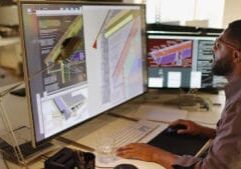
Building Information Modeling (BIM) is currently utilized in more than 60 percent of large-scale construction projects. AI-powered BIM enables teams to simulate the entire project lifecycle, reducing rework and enhancing design accuracy. Studies indicate that AI-enhanced BIM systems can reduce design errors by up to 40 percent. Additionally, real-time data analysis, combined with AI for building construction, helps track project progress and optimizes scheduling, cutting overall project time by 10 to 15 percent, allowing contractors to meet deadlines and stay under budget.
While that has obvious industry-wide implications, there are also implications at the microeconomic level. All things being equal, those contractors that strategize around AI and actually integrate it as fully as possible in product design and executions are likely to be more profitable, prestigious, enjoy greater pricing power for their services, and quickly acquire market share. But many contractors are likely to lack an AI for building construction strategy, in large measure because the technology can presently be characterized as esoteric and intimidating.
Rumo a locais de trabalho mais seguros
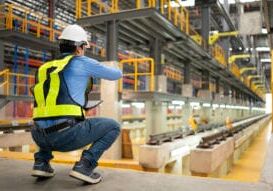
Worker safety remains a critical concern in the construction industry, where risks are substantially higher than in other segments. Nearly 1,000 construction-related deaths occur annually in the U.S. Predictive safety models powered by AI in building construction analyze data from past incidents, taking into account environmental conditions and worker behavior to flag potential hazards. This proactive approach significantly reduces the risk of accidents, with industry estimates suggesting workplace accidents could decrease by as much as 25 percent.
Os wearables com tecnologia de IA também estão se tornando populares, monitorando os sinais vitais e os níveis de fadiga dos trabalhadores em tempo real. Isso permite que os supervisores tomem decisões informadas sobre a necessidade de retirar os funcionários das tarefas se eles estiverem correndo risco de lesão devido à exaustão ou a outros fatores. Pasha Ameli, consultor sênior do Berkeley Research Group, observa que "as ferramentas de segurança baseadas em IA ajudam a reduzir os acidentes relacionados à fadiga, que estão entre as principais causas de lesões no local de trabalho". A importância da IA nesse contexto vai muito além da construção, abrangendo departamentos de obras públicas e aqueles que trabalham em vários aspectos das cadeias de suprimentos.
On projects associated with substantial scale, including large-scale public works, AI-powered drones provide aerial inspections, helping supervisors identify potential problems before they put workers or deadlines at risk. These drones ensure safety compliance and allow for real-time monitoring of hazardous areas. As AI in building construction advances, its ability to quickly detect and analyze risks makes projects safer while chiseling away unnecessary costs. By leveraging these tools, the construction industry is poised to make gigantic strides toward a safer, more efficient work environment, saving lives and reducing injury-related expenses in the process. Safer, more predictable work environments will also inure to the benefit of industry recruitment.
A necessidade é a mãe da invenção ou, neste caso, da mudança de processo. A escassez de mão de obra/competências induziu muitas empreiteiras a adotar soluções baseadas em IA, incluindo máquinas autônomas para lidar com tarefas repetitivas ou perigosas. Bulldozers, escavadeiras e caminhões controlados por IA já estão em uso nos canteiros de obras, reduzindo a necessidade de trabalhadores envolvidos em funções perigosas e aumentando a produtividade. Estudos indicam que o maquinário autônomo pode reduzir os custos de mão de obra em até 30% até a próxima década.
A IA também está transformando a construção robótica. Os robôs com tecnologia de IA estão sendo usados em tarefas como alvenaria, concretagem e demolição. Esses robôs oferecem maior precisão e velocidade do que os métodos tradicionais, levando a uma conclusão mais rápida do projeto e a menos erros. Atul Khanzode, diretor de tecnologia da DPR Construction, enfatiza: "A IA e o aprendizado de máquina ajudarão a automatizar processos que geram desperdício, melhorando a produtividade e os resultados dos projetos nos próximos cinco anos."
When combined with 3D printing, AI in building construction presents a game-changing solution to the housing crisis. The technology enables the rapid construction of affordable homes with minimal waste, reducing building time by up to 60 percent and labor requirements by 70 percent. AI optimizes material use, automates design, and predicts potential construction challenges, ensuring efficient and sustainable projects. This technology allows for the creation of customizable, energy-efficient homes, addressing both cost and supply issues, particularly in regions facing severe housing shortages.
Palavra final
AI in building construction is also able to contribute to mitigating the types of problems that has characterized construction delivery during the pandemic and immediate aftermath. AI can forecast disruptions in materials and equipment delivery, enabling contractors to adjust orders and timelines accordingly. Critically, AI can monitor global supply chains and weather conditions, forming predictions that help construction companies avoid bottlenecks. This can be the difference between a happy client and an unhappy one; between a lawsuit and idle attorneys. As if all this were insufficient, AI can be and is used to analyze supplier performance based on pricing, delivery speed, and reliability, supporting more timely materials delivery at the most advantageous prices. In short, the AI revolution is real and not to be ignored.
Mais sobre a Modular Advantage
MBI Town Halls 2026: Reflections from Boston
By the end of 2026 MBI’s Government Affairs team will have traveled over 6,000 air miles to bring Town Hall events to five different cities in two countries.
Mind the Gap: The Interface Between Onsite and Offsite Construction
Every design for manufacture and assembly (DfMA) project — modular, mass timber, or panelized — is really two projects joined at a seam. One is built in a controlled factory to millimeter tolerances; the other in the field, in weather, to the looser tolerances of poured concrete and human hands. Between them sits an interface: where the factory’s precision meets the site’s reality.
Rules, Rails & Repeatability: Applying DfMA to Modular Healthcare
DfMA offers several advantages for healthcare projects, with faster delivery among the most valuable. Schedule matters when building new facilities, expanding campuses, renovating existing space or bringing care closer to communities that need it.
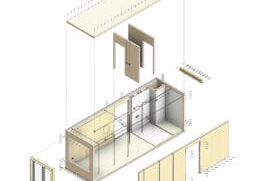
Precision and Possibility: Demands of DfMA and What Modular Mass Timber Makes Possible
Mass timber does not automatically create an efficient modular building. Its precision makes early coordination more important: fabricated components will accurately reproduce both the team’s solutions and its mistakes. The material’s advantages are realized only when supported by an equally precise design and delivery process.
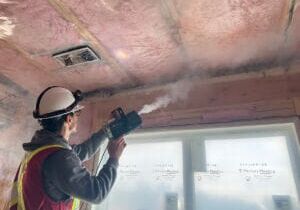
Catch It in the Factory, Not in the Field: Smarter Testing for Modular Builds
Integrating watertightness and airtightness testing into factory workflows transforms quality assurance from a reactive process into a proactive commissioning strategy. It ensures that every module shipped is field ready and resilient for transportation while also supporting the ability of the modular construction industry to make buildings better.
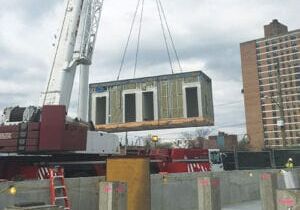
Modular Construction Contracts: Key Considerations for Successful Canadian Projects
Starting a modular project with a well-developed contract protects both the owner and the contractor. It will help keep the project on track and on budget, and it will improve quality from the factory floor to final installation on-site.
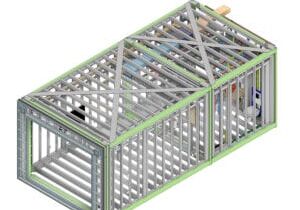
Modular by Design: Turning Architecture into a Manufacturing System
Modular construction is often presented as a faster way to build. Speed, however, is only one part of its value. The larger opportunity is to create a coordinated design and production system that improves quality, reduces uncertainty, and allows a building to move efficiently from concept design through manufacturing, transportation, installation, and completion.
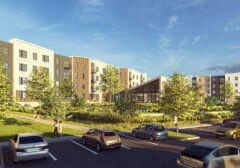
Repeatability Begins with Trust: What Alora at Dry Creek Reveals About Scaling Modular Housing
Alora at Dry Creek, a 329-unit, multifamily community comprising five four-story buildings in Centennial, Colorado, demonstrates how repeatable design, standardized manufacturing and early collaboration can work together to create a model that is not only faster to deliver, but easier to replicate across future projects.
T.R. Arnold: The Art of Third-Party Inspections
T.R. Arnold (TRA), a third-party inspection company in Elkhart, Indiana, contracts with modular manufacturers across the US. Manufacturers register with each state to which they intend to send their modules and may be required to hire a third-party inspection company.
Creating an ‘Ecosystem for Innovation:’ 50+ Years of Modular Construction Oversight in Virginia
Virginia’s modular building program began in 1973, with the implementation of the Virginia Industrialized Building Unit and Mobile Home Safety Regulations. Now it’s leading the country in modular code adoption.